Showing posts with label Book reviews. Show all posts

Thursday, June 27, 2013

Seeing Things Darkly, Seeing Things Clearly

There's nothing like seeing random thoughts, memories, experiences, and a movie collide. It happened to me yesterday. I'm not sure what I expected would happen, but apparently that's what did. I'm still sorting it all out.

I'm reading Jeffrey Overstreet's Through a Screen Darkly: Looking Closer at Beauty, Truth and Evil in the Movies. Even better, I'm reading it as part of an online discussion group with whom I've read some other fabulous books this past year such as The Mind of the Maker which I reviewed last summer. Add to this fun, the author is contributing to the discussion, which makes for intriguing interactions. Overstreet wrote movie reviews for Christianity Today for a number of years, and his work still involves movie criticism, but he's also a gifted author and has written a terrific fantasy series, The Aurelia Thread.

So to say the least, the book is amazing. I have never been a connoisseur of movies; Kraig and I typically watch videos that require little brain engagement--something we can watch at night after the kids are in bed and we're doing some jobs that require hands and not brains (folding laundry, anyone?). But I do like to dissect things--I've always enjoyed literary criticism, or art, and dissecting movies is no different. Also, even though my movie viewing is fairly lightweight, I am always evaluating what I see and holding it up against the grid of what I believe. This book helps challenge that and is forcing me to think more.

It has also piqued my interest to see movies I would never have thought to watch, and why, yesterday, I clicked on a YouTube link to watch the 2004 documentary, Born Into Brothels. You just never know what kind of dangerous territory you may enter when you read, "Jennie knew, as I and so many others have discovered, that Zana Briski's documentary is bursting with joyful surprises and unforgettable characters. She knew that the darkness of the context only makes the lights flare out all the brighter, making this a veritable Fourth of July extravaganza." (p. 188)
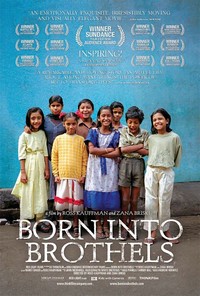
The "unforgettable characters" of this film are the children of prostitutes in the Calcutta red light district. Briski, a photographer, went there in order to record and spread the word of the dire straights people live in in this part of the world. What she hadn't counted on was the curiosity of the children, and she ended up handing out cameras to these kids and teaching them photography. In the process, she saw their world through their eyes, and she recorded it for all the world to see. Overstreet writes, "Even sinful behavior, seen through the lens of a child, can tune the delicate intruments of our hearts so we see things the way they should be. By giving us beauty with the ugliness, joy with the pain, laughter with the groans, these revelations give us a vision more complete and more affecting than any slideshow of poverty and pain half a world away" (p. 189).

The beauty is inescapable. The eyes of these children are dark liquid pools that sparkle to life as they grin. When they are solemn, you feel the weight of their lives. They have wisdom beyond their years and certainly beyond their academic education. And yet it was like they were my Indian neighbors' children who play with my kids. This girl and boy are the children of affluent, educated parents who can travel back to India to see family every couple years. Yet they are as spiritually needy as the children born into brothels, and they have the same beauty as any creation of God. I was humbled, as I thought of how, more often than not, I'm annoyed by these two kids who tend to push my patience, show up at inconvenient times, and get into fights with my kids even as they long to play with them and be friends.

These children of the brothels were like the brother and sister I've been taking to VBS last week and this who live in the apartment complex within a mile of our home. It's a low-income complex that I've known only by reputation for eighteen years until I drove into it for the first time last week. I've gotten to know some of these kids and their parents through my daughter's school, but only at school, not at their homes. In the past couple weeks, I've had to evaluate my attitude. When I drove there after seeing this film yesterday, my mind kept superimposing images of chaotic Calcutta over the neat, quiet townhouses in that complex. What stories were the silent rows hiding inside? It made me wonder if the places were really that different...and if they were really that different from my own white-collar neighborhood. No, I don't live in a city of millions packed in tight quarters, much less even have remote experience with brothels, but isn't my hometown as lost as Calcutta? Aren't the children at my kids' school and in our neighborhood made in the image of God as much as the children that Zana Briski connected with? What am I doing to touch their lives? Am I doing all that I can to seek the beauty in them and help them connect to the Giver of True Beauty?

I am awash with this storm of thoughts and am still trying to process this. It was all so familiar, perhaps in part because there were cultural bits in the film that reminded me so much of my childhood in the Philippines. And I think it was also familiar because it was such a true picture of humanity. The joy in the film made the sorrow that much more poignant and real. So much more something that must be opposed.

I'm praying that I will be faithful to what God wants me to do to take part in this battle.


Monday, July 30, 2012

Problems, Solutions...Or Something New?

Early this summer I picked up a book that I'd seen recommended a number of times: The Mind of the Maker, by Dorothy L. Sayers. I'm an old fan of Sayers' Lord Peter Wimsey mystery novels, but I hadn't forged past those to read her other writings, many that highlight her insights into living for Christ. The Mind of the Maker seemed a good place to start, and when a blog friend of mine started an online discussion of the book within weeks of my venture, it proved to be the perfect summer read. Not to mention, having a group discussion helped me pace it and push on through the heavier bits.

And what a journey it has been! I can definitely say that I loved Sayers' writing as much in this book as I always have in her novels. I wish I could think like her; she lays ideas out, elaborates, focuses in, and zings with her final points. She's a master of logical arguments. Kraig could probably keep pace with her, but for me it's a slow process. But her work is as beautiful as a perfect geometry theorem (and from a non-math-person like me, that's a huge complement). My favorite part of the book was chapter seven, "Maker of All Things--Maker of Ill Things," in which Sayers lays out an argument for why evil exists and the part God plays in it. I won't even attempt to detail it here because I would completely botch her argument, so you'll just have to go read it yourself. There is this point with which she concludes the chapter, though, that goes with what I'm getting to:
"The Fall had taken place and Evil had been called into active existence; the only way to transmute Evil into Good was to redeem it by creation. But, the Evil having been experienced, it could be redeemed only within the medium of experience--that is, by an incarnation in which experience was fully and freely in accordance with the Idea [God]." (p. 107)
So the Creator God gave us Christ, and through Christ, we (and all of His creation) can be redeemed, bought back, rescued.

In the final chapter, Chapter 11, "Problem Picture," Sayers fleshes out this concept of redemption. She targets a cultural tendency that thinks of everything in terms of problems and solutions. Think of how we approach everything: Here is the problem (e.g. "I am sick") and here is the solution ("I will follow such-and-such procedure and I will be cured."). Unfortunately, reality is not that cut and dry. We don't have neat little problems, Sayers points out, like a detective novel that can be solved with all the pieces tied up.

For many people, the fact that the problems of life can't be neatly solved is horrible. What kind of God would make a world that can't be fixed? But the whole point is, that isn't how God works! He doesn't "solve" the "problem" by what we think of as "fixing it". If that were the case, when Adam and Eve admitted to eating the fruit, He would have simply restored Eden to its innocence, knocked Satan out of the picture forever, and that would have been that. Nice idea, but within the construct of His creation it doesn't work. Innocence was lost, Evil was active, and the knowledge of good and evil had entered into the human soul. The only true solution was redemption. A price had to be paid in order to buy us back. All things could only be made new through Christ's sacrifice.

Sayers takes this concept of making things new into our human realm, for her theory is that as God is the Creator, his creation reflects Him; therefore, humans have a desire to create--we have the mind of a maker :) . Humans desire to make something new out of what we have. Obviously we reflect God dimly, particularly because of sin, but the image is there and now and then shines out (more so as we let Christ live through us). So with that perspective, how do we deal with the problems of life? We don't try to "solve" them and restore things to what they were before the problem existed; that's impossible. The person who successfully fights off cancer will never be restored to the same state of health he was in previous to the illness. He will never be that same person mentally or spiritually, either. He has been made new. His life is now a new creation.
"If, therefore, we are to deal with our 'problems' in 'a creative way,' we must deal with them along the artist's lines: not expecting to 'solve' them by a detective trick, but to 'make something of them,' even when they are, strictly speaking, insoluble." (p. 193)
 I realized that this has been how I've looked at problems for a long time. When Keren died, what put my feelings into words for me was Steve Saint's article, "God's Purpose In Our Suffering." I believed God was in control and that Keren's death wasn't some pointless tragedy. But when I read how this man came to see that God had purposed a tragedy in his family's life to bring others to Christ and bring God glory I saw hope. Keren's life and death was not in vain. Even our grief in losing her wasn't pointless. There was no need to try to "solve" our "problem" of grief. God could take it all, would take it all, and make it something more beautiful than I could ever imagine. And in the past three-and-a-half years I've seen flashes of that truth, and I have no doubt I will continue to see it. Kraig and I are still figuring out what all this means for our future.


Our pastor recently started a series on Nehemiah, and has been focusing on how the rebuilding of the wall of Jerusalem is similar to ways our church is trying to rebuild after a number of years of upheaval. Sunday he spoke on chapter four and "Dealing with the Inevitable." In other words, when you are in the midst of doing something big for God, it is inevitable that obstacles will arise. It is easy to get discouraged and sidetracked: "It will never be the way it was! There are too many problems, we can't fix them!" The truth is that of course things won't be the way they were, and that there are problems. But that's not the whole truth. God's truth is that He can use us, and work through us to create something new and mighty and beautiful, and that we will be strengthened through the problems we face, and the world will see His glory.

It hit me this morning that another area where this applies for me is with our mom's group at church, REAL moms, of which I'm the coordinator. In the past number of years we have watched our numbers and resources shrink considerably. There are many factors as to why this is, but I've often fought discouragement concerning this. After all, we were such a great outreach program for the church, and we still have many amazing resources for moms of young kids. Why can't we still be that? What can we do to go back to that? Thankfully I've had a mentor and a team who have encouraged me to see what God is doing now in a new way. Last year, though our group was small, it became a place where women could come and share things that were going on in their lives, things they may not have been comfortable to share in a bigger group. Our team saw that our role was one of equipping and challenging each mom to go out into her own community and live Christ daily. It became a place of discipleship more than evangelism, which is awesome, particularly if each person is then becoming a light in her own neighborhood. I'm excited to see how God will continue to use each of us in the group.

I realized that I've got to act on this perspective of making things "new creations". I'm not going to look for simple 1-2-3 solutions to restore things to how they were. I won't expect to see things wrapped up in a nice little package with a bow on top. No, I will look to see how God is making things new, and I will strive to work in God's creation to make something of what He has given me. And to Him be the glory, forever!
 

Thursday, December 01, 2011

Understanding the Big Picture


I love stories. I love seeing my kids’ eyes light up when they listen to good stories. And the best stories, I think, are the ones that give a glimmer of something more than. It doesn’t have to be laid out like Aesop’s Fables, “And the moral of the story is...,” but the best stories are definitely the ones that have more to them than a plot-line.

And the greatest story of all is, no question, the story of God’s Big Rescue Plan. Most of us know something of this story, and we hear a good bit about it around Christmas. But usually we only hear one part: Jesus, God’s Son, is born on a starry night and laid in a feeding trough. If we’re more knowledgeable, we know that this baby grows up to do all kinds of wonderful miracles and tell marvelous stories himself, but in the end he’s horribly murdered—for us!—and then, beyond comprehension, rises again!

So if that’s the main story of God’s Big Rescue Plan, what does the rest of the Bible have to do with it? Are the other stories in the Bible just there to give us guidance in how to live our lives (or how not to, as the case often is)? Most children’s books and videos that portray these stories seem to imply this. Two newer contributions to the wealth of kids’ books and videos, though, go a major step beyond the norm and bring out the full beauty and wealth of the greatest story out there.

First off is The Jesus Storybook Bible: Every Story Whispers His Name, by Sally Lloyd-Jones. We were introduced to this book in the fall of 2007, and I’ve lost count of how many times our family has read it through since. Colorful illustrations catch the eye of littlest ones, and the creative storytelling grasps the imaginations of kids as young as three or four…and as old as 90 or 100 J . Lloyd-Jones skillfully weaves the truth of Jesus and God’s Big Rescue Plan from Adam & Eve through Revelation. Not every part of the Bible is covered, of course, but each story included shows a connection to Christ. The way she puts things has grabbed my heart more times than I can say. It has deeply affected how my kids see Jesus and heaven, and their place in the big picture. You can find this book at Family Christian Stores, though I’ve found it’s cheaper through Amazon.


Secondly, a new video series, What’s In the Bible?, has been a huge hit at our house this year. The creator of this series is Phil Vischer, otherwise known as “Bob the Tomato” of VeggieTales fame. In these new videos, you don’t have talking vegetables, but rather an eclectic cast of puppets who dig into the Bible and pull out some fascinating stuff. It’s full of the type of humor you find in VeggieTales, along with fun, catchy songs and silly cartoons. At the same time, it lays the Bible out clearly without ignoring some of the tough questions like “What is salvation?” “What is the Trinity?” “Why does God tell the Israelites to kill people? Isn’t He the God of love?” And once again, woven through is God’s Big Rescue Plan. So far six videos have been put out in this series, and they’ve made it through 1 & 2 Chronicles in the Old Testament. It looks like there will be about thirteen videos in the end, and they’re coming out quickly. If you want to find out more about this series, or watch other videos with the characters, check out http://www.jellytelly.com/ and http://whatsinthebible.com/. I just discovered, too, that there’s a new stand-alone video called Buck Denver asks Why Do We Call It Christmas? I want to see it!!!
 
So there you have it! Quality stuff to check out for the Christmas season. Your kids will love it, and you’ll probably enjoy it as well!